

British Columbia will not restore U.S. products to B.C. Liquor Store shelves until the ongoing trade and tariff disputes with the United States are settled, as stated by the province’s minister for jobs and economic growth.
Ravi Kahlon expressed these views on Wednesday, following comments from U.S. Commerce Secretary Howard Lutnick during a Senate hearing, where he criticized Canadian provinces for maintaining the ban.
“I tell Canadians and British Columbians eager for Kentucky bourbon that they will need to wait until the tariffs imposed by the U.S. are resolved,” Kahlon remarked.
“We have yet to see any progress regarding the unfair tariffs placed on Canada, particularly affecting B.C., and we also feel disrespected through media and public statements. Therefore, we find no reason to alter our stance at this time.”
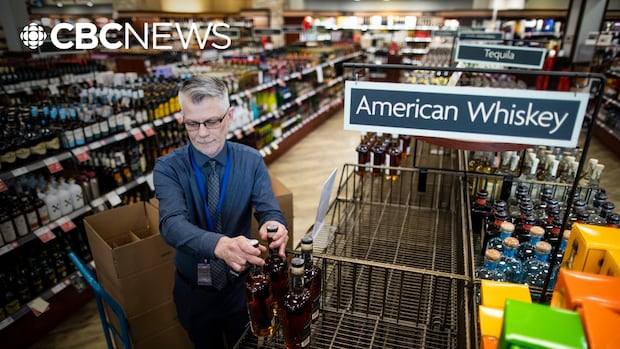
B.C. initially banned liquor from U.S. states governed by Republicans. Now, all American alcohol is being removed from shelves in government-operated stores. Premier David Eby stated this action responds to “escalating threats” from the U.S. Meanwhile, Chad Pawson reports that the premier is also making personal choices to prioritize Canadian products.
Restaurants seek flexibility
Ian Tostenson, president and CEO of the B.C. Restaurant and Food Services Association, remarked that the year-old ban is negatively impacting the hospitality industry, urging the province to consider adjustments, particularly for wholesale clients.
“The revenue generated from U.S. wines used to be around $150 million annually. Now, it has fallen to $80 million, and the Liquor Distribution Branch has not compensated for that loss,” he informed CBC News.
“This means we are losing roughly $70 million due to the measures we’ve implemented, which is a significant amount.”
He also noted that the ban affects importers and distributors, which the restaurant sector depends on.
At the same time, he mentioned that some consumers continue to purchase U.S. products by either visiting private liquor stores that are selling off B.C.’s inventory or by obtaining them from Alberta.
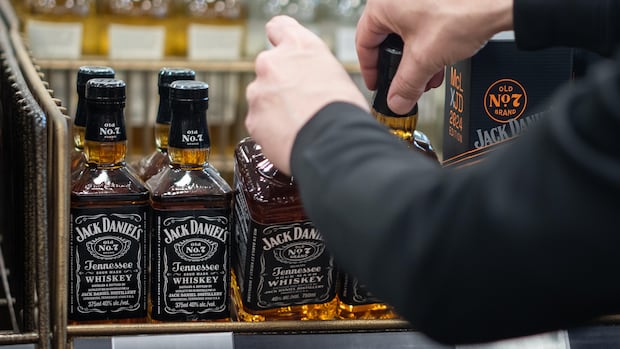
Consumers in Alberta and Saskatchewan can now find U.S. liquor back on store shelves after these provinces lifted their bans on American-made alcohol. Andrew Ferguson, an independent liquor store owner, mentions he does not anticipate a significant impact from this change, as the demand for American products remains low.
Tostenson emphasized that the hospitality sector continues to strongly support B.C. wine and spirits.
However, he pointed out that numerous products cannot be directly substituted on menus, resulting in businesses being inadequately stocked as the 2026 FIFA World Cup approaches.
“If the government opts not to sell these items in liquor stores as they currently do, then at the very least allow the private sector… the chance to do so,” he suggested.
“If consumers are not interested in purchasing them, they simply won’t.”
Trade concern
British Columbia, along with other provinces like Ontario and Quebec, removed U.S. liquor products from shelves last year in response to tariffs imposed by U.S. President Donald Trump and threats to make Canada the “51st state.”
These provinces represent almost two-thirds of Canada’s population, and the wine and spirits industries in the U.S. have since indicated that the ban is impacting their profits.
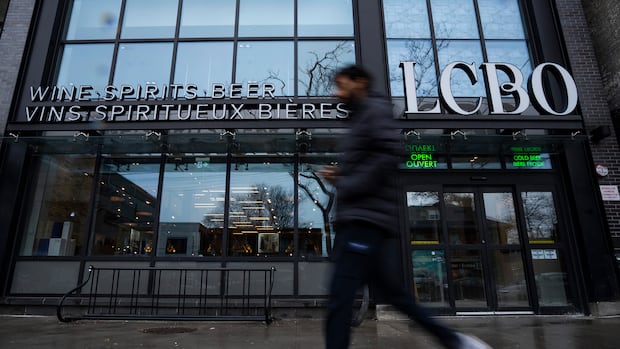
The Distilled Spirits Council of the United States claims that Canadian retailers are providing an unfair advantage to local spirits. In contrast, some Canadian distilleries state that the removal of U.S. liquor from shelves has only resulted in a slight uptick in their sales.
The U.S. has identified this issue as a significant irritant heading into challenging negotiations to revise the Canada-U.S.-Mexico Agreement (CUSMA) regarding trade.
On Thursday, Prime Minister Mark Carney indicated that the provinces might quickly lift their bans if the U.S. were to retract tariffs on vital Canadian industries such as steel, lumber, and automotive manufacturing.
“We can achieve rapid progress in that area with advancements in others,” Carney remarked to reporters at a housing news conference in Ottawa.
“What is truly an irritant? A 50 percent tariff on steel and aluminum, 25 percent on automobiles, and various tariffs on forest products. Those are more than just irritants; they constitute violations of our trade agreement, understood?”
Kahlon dismissed the notion that the liquor situation was obstructing CUSMA negotiations.
“It’s difficult to believe that would be the case,” he stated.
“If it is, that should serve as an even greater incentive for the U.S. to engage in discussions and seek a resolution.”
Ontario Premier Doug Ford has also turned down requests to restore U.S. liquor to store shelves.