

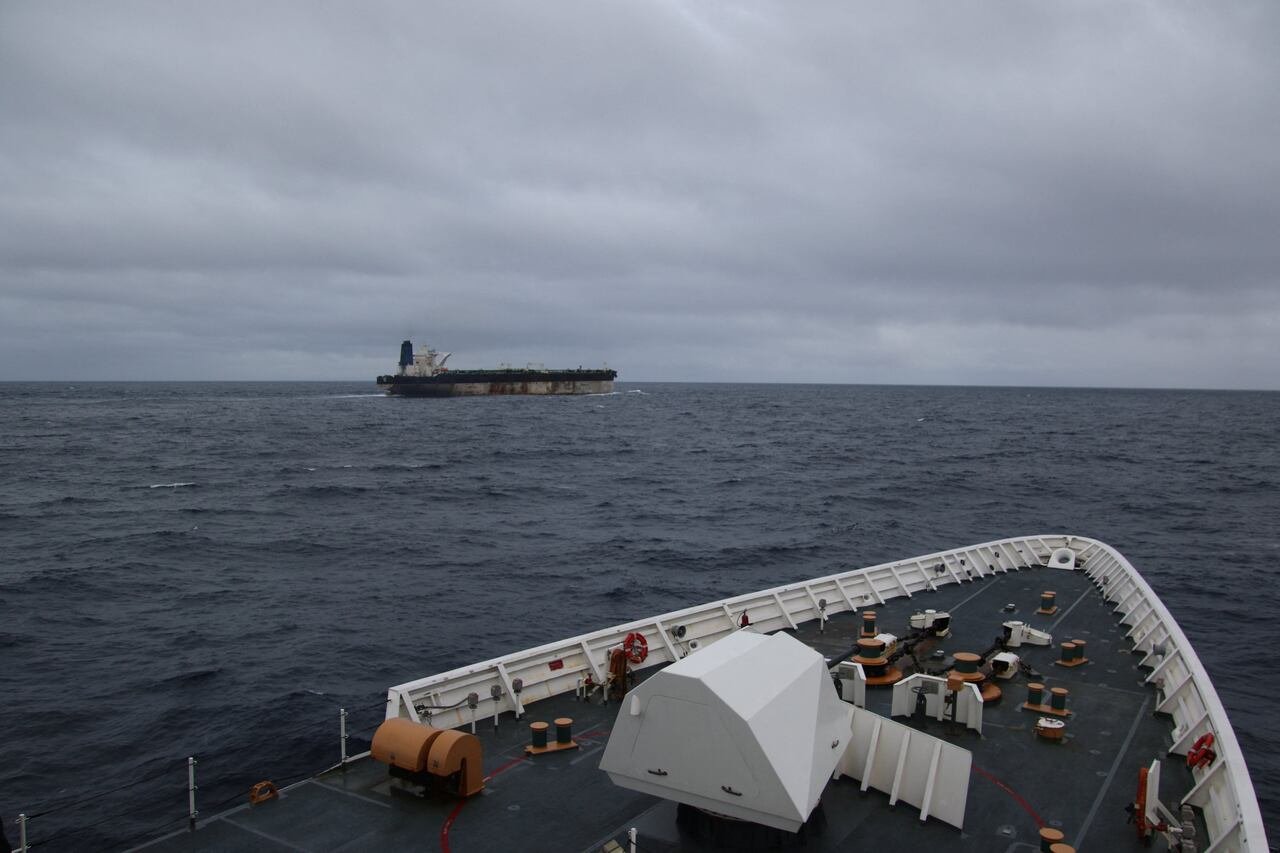
Tracking the crude tanker Marinera as it navigated the North Atlantic towards Russia, the U.S. Coast Guard maintained surveillance for over two weeks in line with its efforts to restrict Venezuelan oil shipments. The vessel altered its route, name, and flag during this period, as documented in shipping databases. It was reported that the crew hurriedly painted a Russian flag on the aged hull.
Despite these maneuvers, the U.S., aided by the U.K., seized control of the vessel on Wednesday near the south coast of Iceland. U.S. officials stated that the seizure was part of Washington’s strategy to target ships deemed as threats to the security and stability of the “Western hemisphere.”
Russia, which had dispatched a submarine and other military assets to the region, denounced the seizure as unlawful, with a lawmaker labeling it as piracy.
Experts in maritime intelligence at Windward, a global firm headquartered in London, noted the rare occurrence of a NATO country apprehending a Russian ship in international waters. They anticipate more tankers falling under U.S. control as pressure intensifies on Venezuela, suggesting that additional Russian vessels may also be impacted.
Michelle Wiese Bockmann, a maritime intelligence analyst at Windward, highlighted the likelihood of more seizures, emphasizing the U.S.’s capability to interdict and seize non-compliant tankers.
The potential response from Russia following the seizure remains uncertain, raising questions about its impact on the global shadow fleet, clandestine vessels with ambiguous ownership structures that engage in deceptive shipping practices to evade sanctions.
With the U.S. taking control of four Venezuelan-affiliated tankers since December, including two seized recently, concerns have escalated. The U.S. Southern Command also intercepted a “stateless, sanctioned, dark fleet” tanker in the Caribbean Sea prior to the Marinera’s seizure.
Experts pointed out the deceptive practices of vessels like the M/T Sophia, which frequently visited Venezuelan ports and engaged in spoofing its location. Similar concerns were raised about the Marinera’s history of trade with Iran and Venezuela before its interception en route to Murmansk, Russia.
The rush to be flagged to Russia
Notably, 21 falsely flagged dark fleet tankers, including the Marinera, switched their flags to Russia in recent months, indicating a growing trend. This shift has accelerated since the initial tanker interception in December.
Vessels are classified as “falsely flagged” if they claim registration to a country where they lack legal status, possess a terminated registration, or frequently alter flags to evade oversight. Such ships can be boarded in international waters under the UN Convention of the Law of the Sea if deemed stateless.
The risk of seizure due to statelessness has prompted several ships to re-flag as Russian, minimizing vulnerability to enforcement actions. The Russian transport ministry granted “temporary permission” for the Marinera to sail under the Russian flag, emphasizing the crew’s humane treatment and swift repatriation.
Amidst these developments, the U.S.’s assertive actions may trigger more seizures globally, prompting NATO countries to enhance maritime surveillance to counter