

A disagreement surrounding a vessel laden with pilfered grain has revealed a geopolitical dynamic that has existed for years yet often goes unacknowledged in Western political arenas and media: the surprisingly amicable ties between Israeli Prime Minister Benjamin Netanyahu and Russian President Vladimir Putin.
Recently, Ukrainian President Volodymyr Zelenskyy voiced his concerns on X about a Panama-flagged ship set to unload 25,000 tonnes of wheat and barley unlawfully taken from Ukraine in Haifa, Israel. An inquiry conducted by the Israeli newspaper Ha’aretz indicates that the Panormitis was at least the fifth vessel this year to transport grain misappropriated from occupied Ukraine to Israel.
“In any typical nation, acquiring stolen goods incurs legal responsibility,” Zelenskyy stated. “This cannot — and must not — be deemed legitimate commerce. The Israeli authorities cannot claim ignorance regarding which vessels are docking at the nation’s ports and the nature of their cargo.”
The Ukrainian government has lodged a criminal complaint in Israel against those it accuses of purchasing the grain after its appeals for action from Israeli officials were met with hostile admonitions from the Netanyahu administration.
Zelenskyy, one of only two Jewish leaders outside Israel (the other being Mexican President Claudia Sheinbaum), might be anticipated to have a more favorable rapport with the Jewish state. However, Ukraine has consistently faced rejection in efforts to safeguard Israel’s ties with Russia.
Recent frustration has escalated into outrage, as Kyiv accuses Israel of exploiting its plight and collaborating with its principal adversary.
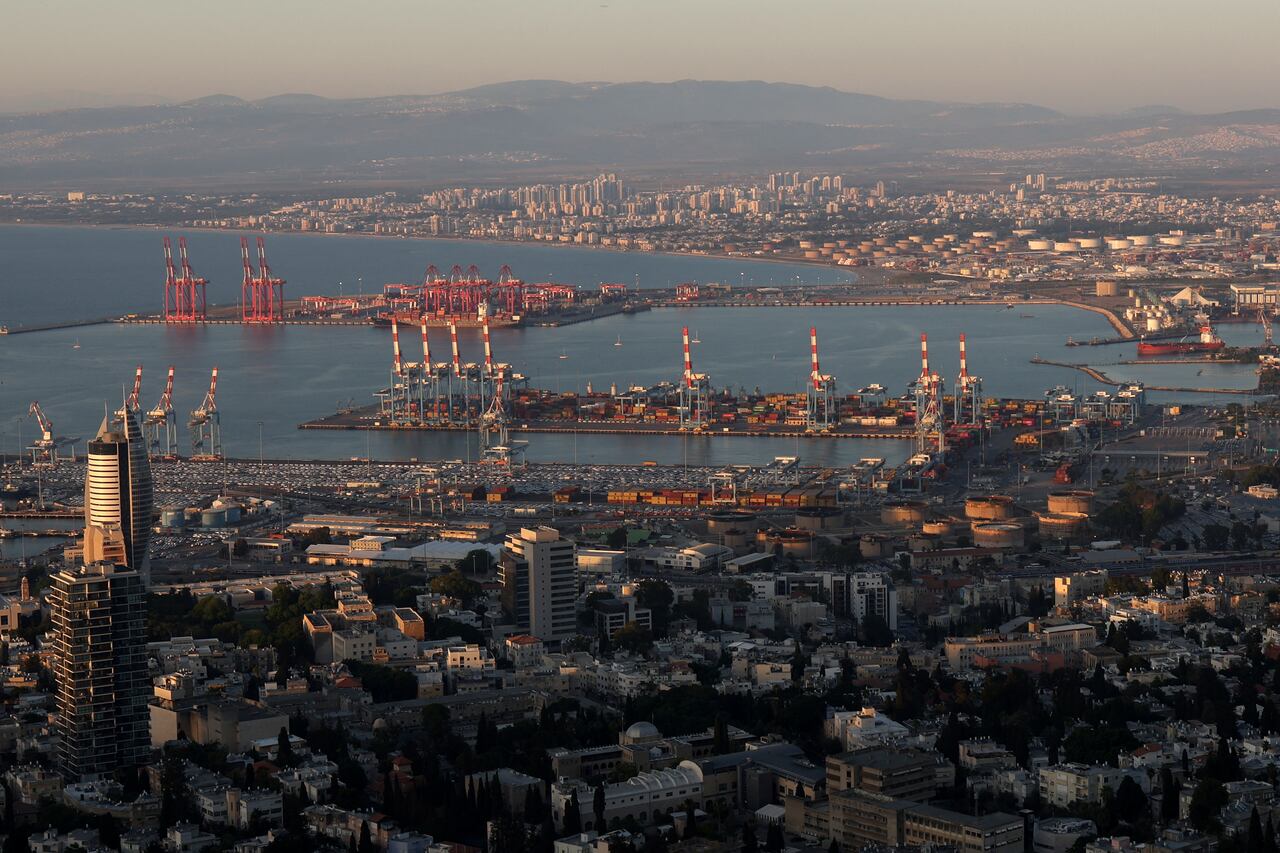
Last month, the Panama-flagged Panormitis transported 25,000 tonnes of grain harvested in Russian-occupied Ukraine to Haifa, Israel. On April 30, the vessel departed Haifa without discharging its cargo. (Florion Goga/Reuters)
‘Systematic grain theft’
“Russia is systematically appropriating grain from temporarily occupied Ukrainian territories and facilitating its export through individuals affiliated with the occupiers,” Zelenskyy posted on April 28. “Such operations contravene Israeli law itself. Ukraine has taken all necessary diplomatic steps to avert such occurrences. Yet, we observe that yet another vessel has evaded intervention.”
Zelenskyy cautioned that Ukraine is preparing a “sanctions package addressing both those directly involved in transporting this grain and the individuals and entities seeking to gain from this unlawful scheme.”
The European Union has expressed support for Ukraine, threatening its own sanctions.
“We denounce all actions that assist in financing Russia’s unlawful military campaign,” stated EU foreign affairs spokesperson Anouar El Anouni, “and we stand ready to target such actions by identifying individuals and entities in third nations if needed.”
Rather than extending an apology, Israel’s Foreign Minister Gideon Sa’ar vehemently accused Ukraine of engaging in Twitter diplomacy.
“Allegations do not constitute evidence,” he tweeted. “No evidence supporting the claims has been provided. You did not even submit a legal assistance request prior to approaching the media and social networks.”
Ukrainian officials contend they resorted to public appeals only after Israel disregarded their diplomatic overtures.
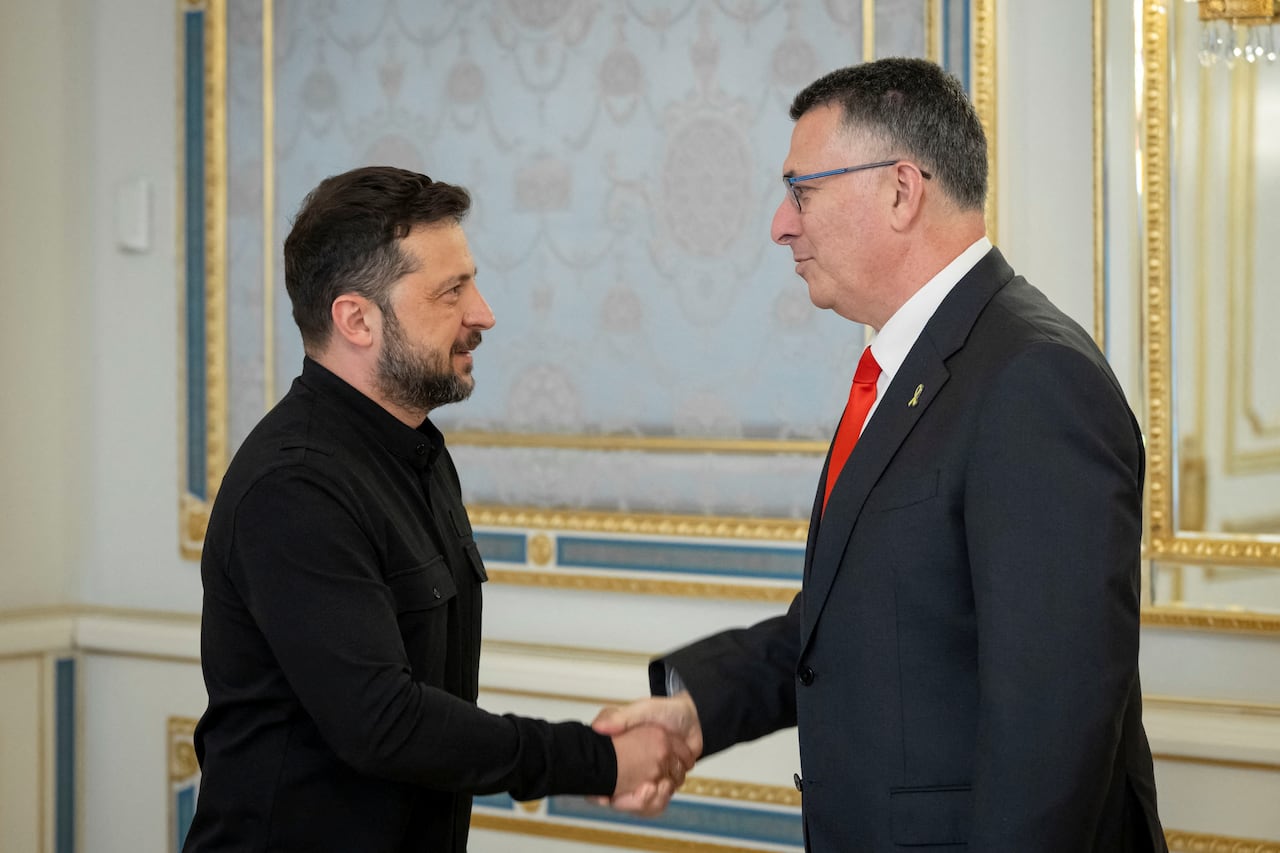
President Volodymyr Zelenskyy of Ukraine greets Israeli Foreign Minister Gideon Sa’ar in Kyiv on July 23, 2025. More recently, the two have exchanged barbs online regarding Russia’s grain shipments to Israel. (Ukrainian Presidential Press Service/Handout via Reuters)
A ‘cold and distant’ relationship
Former Israeli diplomat Alon Pinkas remarked to CBC News that Israel’s denials lack sincerity.
“The Israeli government asserts that the Ukrainians failed to provide the appropriate documentation, which led to the misunderstanding. The Ukrainians are effectively saying, ‘Look, there have been several others over the past few years, so don’t pretend to be naive with us.’
Maria Popova from McGill University, co-author of the book Russia and Ukraine: Entangled Histories, Diverging States, stated that the discord simply highlights tensions that have long existed.
“The relationship has been chilly and remote throughout the four years following Russia’s full-scale invasion,” she told CBC News. “Israel has not acted as an ally to Ukraine in the same manner that Europe and Canada have, and the U.S. did under Biden.”
The Ukrainians are extremely frustrated with Israel’s conduct since the Russian invasion. They view this as part of Israel’s duplicitous actions.Alon Pinkas, former Israeli diplomat
Sa’ar escalated his criticisms of Ukraine during a joint press conference with Serbia’s Foreign Minister Marko Djuric, suggesting that the allegations were “somewhat surprising coming from a nation that we have supported in international arenas.”
This remark likely raised eyebrows in Kyiv, according to Pinkas, since the Israeli administration has not supported Ukraine on the global stage when it has been most crucial. When Russia annexed Crimea in 2014, the Netanyahu government resisted U.S. pressure to denounce it.
Instead, Prime Minister Benjamin Netanyahu and his Soviet-born foreign minister Avigdor Lieberman emphasized Israel’s neutrality, which frustrated the Obama administration as they abstained from a UN vote condemning Russia’s aggression.
“We maintain positive and trusting relations with both the Americans and the Russians, and our experiences with both have been very constructive. Therefore, I don’t see why Israel should become embroiled in this,” Lieberman told Israel’s Channel 9 News.
Israel reluctant to denounce invasion
This pattern repeated itself when Russia commenced its full-scale invasion of Ukraine in 2022, Pinkas noted.
“A new government led by Naftali Bennett was in place. They, too, were not particularly pro-Ukrainian. The U.S. specifically requested that the government take a stance.”
Nevertheless, Israel again refrained from condemning Russia, according to Pinkas, partly due to ongoing coordination between the two nations in Syria at that time.
Many Israeli observers believed the conflict would be brief and that Ukraine would quickly fall. However, this assumption proved incorrect.
“Months passed. The U.S. under Joe Biden fully committed to Ukraine, NATO also pledged complete support, yet Israel still did not condemn Russia.”
Popova concurred that Israel’s focus on events in Syria made it hesitant to confront Russia during the civil war there, “but even after the regime change in Syria, we did not witness Israel providing substantial assistance to Ukraine.”
Pinkas believes the grain dispute has finally exposed Ukraine’s discontent.
“The Ukrainians are very upset with Israel’s actions since the Russian invasion. They perceive this as indicative of Israel’s duplicitous behavior.”

A man and his dog stroll past a building in Tel Aviv illuminated in the colors of the Ukrainian flag on November 19, 2024, marking 1,000 days since Russia’s full-scale invasion of Ukraine. (Nir Elias/Reuters)
Israel ‘almost a Russian-speaking nation’: Putin
In Israel, the government’s hesitance to denounce Russia has sparked growing controversy, particularly as Russia aligns more closely with Tehran.
Reports indicate that Russia may have assisted Iran in targeting Israeli energy facilities, though other accounts suggest that Russia has limited its support to aiding Iran in striking U.S. interests in the Middle East.
During a 12-day confrontation between Iran and Israel in June 2025, shortly after Russia and Iran finalized a comprehensive partnership agreement, Putin opted not to back his new ally, justifying his inaction by stating, “Israel is almost a Russian-speaking country.”
This wasn’t the first occasion he made such remarks. Putin has even claimed that popular Israeli songs originated from Russia.
“Russians and Israelis share familial and friendly connections,” he stated in 2019. “The views of Russia and Israel, the peoples of our nations, are aligned.”
Russia has shown limited willingness to aid Iran in the current conflict, provoking criticism from the Islamic Republic’s ambassador in Moscow, Nematollah Izadi.
“Moscow will inevitably have to answer history for this silence,” he told Iran’s Shargh Daily.
Tehran officials have been relatively restrained in their critiques, at least publicly.
Israel cautious about parallels with Russia
“The Russians are engaging in a very treacherous game here,” Pinkas observed, noting that it should have been a pivotal moment when Iran established a Shahed drone assembly facility in Crimea, yet “Israel still did not adopt a pro-Ukrainian stance.”
“I understand that with such a massive entity as Russia nearby and a population of 1.2 million Russian speakers, exercising caution in taking a decisive position is prudent. However, it’s increasingly strange how much Israel is in denial regarding Russian-Iranian collaboration.”
Another consideration influencing Israel’s stance is that Israeli diplomats recognize that criticizing Russia’s actions may draw attention to parallels with Israel itself.
“On what grounds should Israel oppose Russia? If it’s about the illegal occupation of land, then Israel will be held accountable for that,” he stated. “Thus, Israel has maintained a low profile.”
This applies to allegations that Russia targets Ukrainian civilians, Pinkas noted. While Israel, in contrast to Russia, can assert it is responding to aggression, “Israel finds it challenging to confront and denounce Russian actions due to concerns of being told, ‘Isn’t this what you’re doing?'”
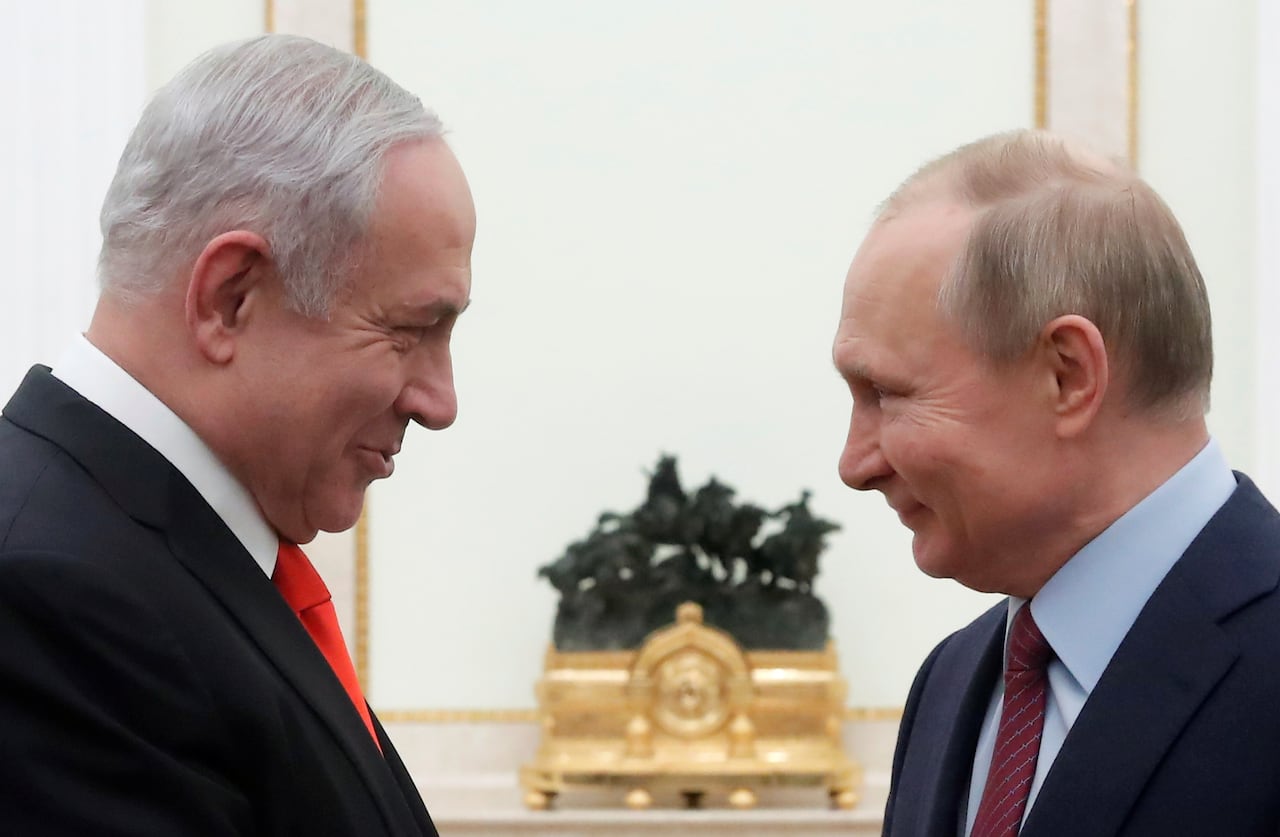
President Vladimir Putin of Russia meets with Prime Minister Benjamin Netanyahu of Israel in Moscow on January 30, 2020. (Maxim Shemetov/Pool/Reuters)
Two wanted leaders overseeing occupied territories
Both Israel and Russia are unique in that their leaders are sought by the International Criminal Court for purported war crimes. (Each country has one additional official also under scrutiny.)
Both nations control occupied areas and have claimed annexations that lack global recognition and seem to violate the UN Charter. The parallels extend further, according to Popova.
“Russia has no authority to confiscate and trade this grain,” she asserted. “It’s not Russia’s grain, and that constitutes a violation of international law known as pillage.”
Israel similarly capitalizes on the resources of occupied territories for its benefit.
“The resemblance is clearly evident,” Popova stated, “and this may be another reason why it’s not in Israel’s interest to vehemently criticize Russia for occupying portions of Ukraine and exploiting the resources within those areas.”
Popova explained that while Ukraine may have previously hesitated to call out Israel, partially due to a desire to maintain favorable relations with the United States, recent Ukrainian battlefield achievements and developments in the Persian Gulf have altered the dynamics.
“Zelenskyy now possesses greater confidence to assert Ukrainian interests on the global stage. Ukraine has formed alliances in the Middle East, aided by its advanced military industry, which now provides security assistance to various nations. Ukraine has essentially transitioned into a security provider instead of merely a security recipient,” she noted.
“Therefore, [Zelenskyy] now has the opportunity to be more candid about the current situation.”
For the time being, he seems to have prevailed in the dispute. On April 30, the Panormitis departed Haifa without unloading its cargo. Ukrainian officials have indicated they will continue to monitor the ship and its pilfered grain.