

On Monday, the European Space Agency announced that the BepiColombo mission, a collaborative effort between Europe and Japan to study Mercury, remains “on track” and that the spacecraft is secure despite experiencing a minor issue upon entering orbit around the solar system’s smallest planet.
ESA confirmed on Saturday that BepiColombo successfully reached orbit above Mercury after an eight-year journey from Earth. However, it revealed on Sunday that the thrusters intended to adjust the spacecraft’s position fired for a shorter duration than expected.
In a statement released on Monday, the space agency asserted that “BepiColombo is safe and in a stable orbit around Mercury.”
The robotic spacecraft comprises ESA’s Mercury Planetary Orbiter and Japan’s Mercury Magnetospheric Orbiter, which have distinct scientific goals and are scheduled to separate in the coming weeks.
ESA reiterated on Monday that the mission is “on track for the separation of its two science orbiters” on December 9 as originally planned.
The agency indicated that teams at its European Space Operations Centre collaborated with the lead spacecraft manufacturer Airbus and other partners to investigate the thruster malfunction, which “has been traced to a software glitch.”
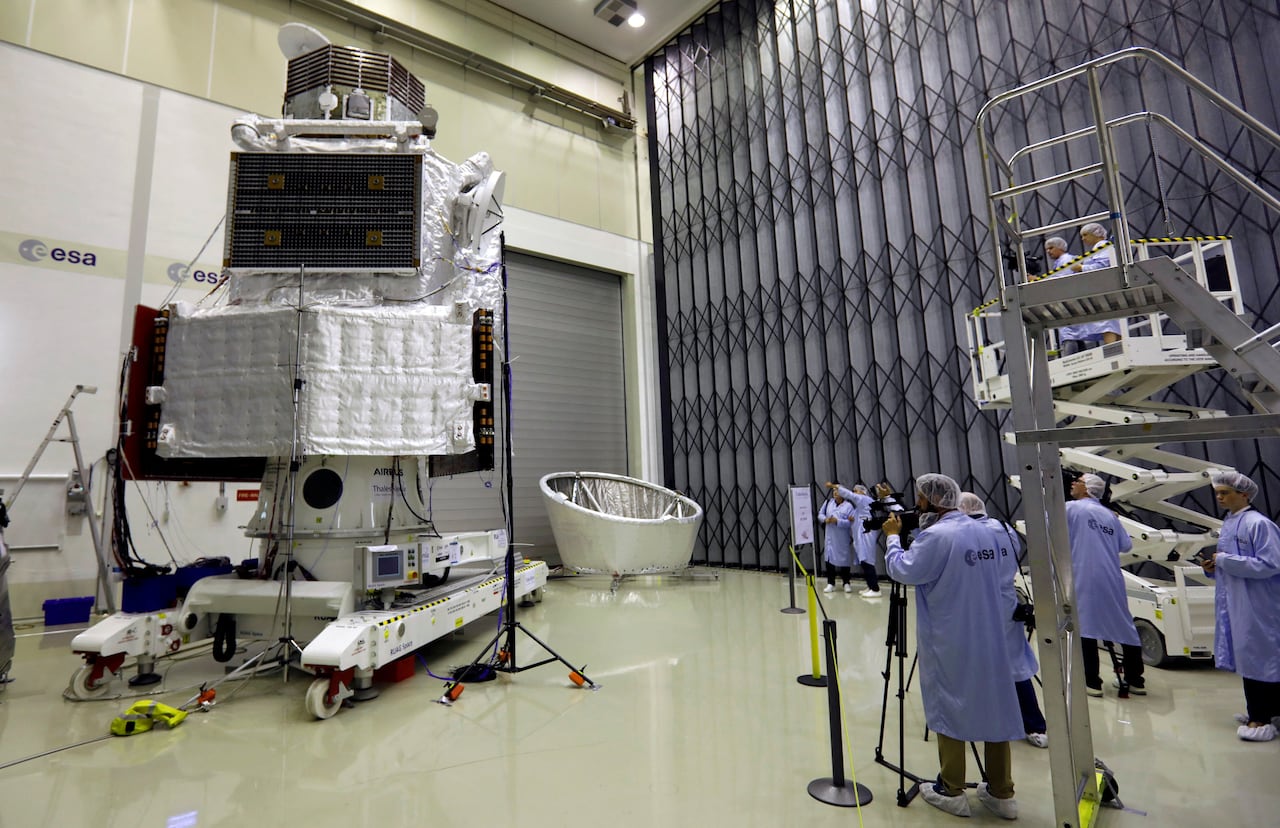
The spacecraft BepiColombo is seen at the European Space Agency’s European Space Research and Technology Centre in Noordwijk, Netherlands, in July 2017. (Michael Kooren/Reuters)
ESA reported that as BepiColombo flew 635 kilometers above Mercury’s surface, the thrusters activated as anticipated.
This burn was expected to last for 37 minutes, sufficiently decelerating the spacecraft to secure its orbit. Instead, the operation was “autonomously interrupted, and the spacecraft entered safe mode, a protective state designed to maintain safety by halting all non-essential activities in the event of unexpected circumstances,” according to ESA.
-
The new milestone Voyager 1 just crossed in interstellar space
-
SpaceX Starship successfully re-docks at Texas launch pad after orbiting Earth
ESA determined that, due to the premature end of the burn, the spacecraft achieved approximately 77 percent of the desired velocity change. Additional thruster burns are planned for the upcoming months to adjust BepiColombo’s orbit.
Routine scientific operations are expected to begin in April, according to ESA.
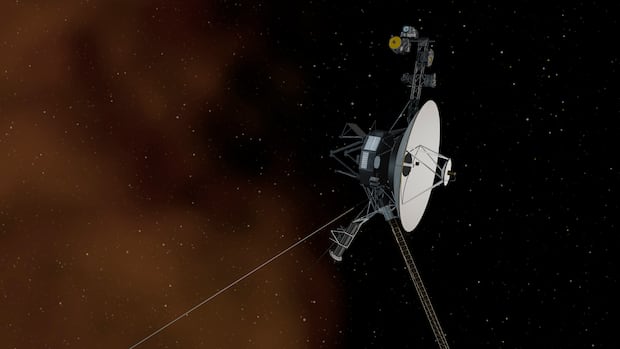
It took 49 years for the Voyager 1 spacecraft to travel 25.9 billion kilometres from Earth, the farthest point for any human-made object. It’s now so far away that it takes light — and radio signals — a full day to reach it from Earth.
The mission control team operates from Darmstadt, Germany.
Mercury, which is only slightly bigger than Earth’s moon, is the least studied of the four planets in the inner solar system. BepiColombo is only the third spacecraft to reach Mercury and the second to achieve orbit around it.
This mission aims to address several questions regarding Mercury, including the reasons behind its magnetic field, the presence of ice in the polar craters of this sun-baked planet, and the characteristics of mysterious depressions known as “hollows” on its surface.
BepiColombo was launched in 2018.