

On February 28, debris from an Iranian missile that was intercepted impacted the Fairmont The Palm, a luxury hotel situated on Dubai’s lavish artificial island, undermining not only the nation’s sophisticated missile defense system but also its meticulously constructed image of safety.
For many years, the United Arab Emirates has established itself as a center for commerce and culture, serving as a bridge between European and Asian markets.
“The U.A.E. specifically, and the Gulf region more broadly, have portrayed themselves as a refuge amidst a surrounding sea of chaos for the last four decades … and that perception has now been shattered,” remarked Stephen J. Fallon, a political analyst who spent eight years in the country and is currently based in Ireland.
Security and stability have been defining characteristics of life in the Emirates. Over the years, millions have been drawn to the nation, lured by its pristine streets and sparkling skyscrapers that rise from the desert landscape to touch the sky.
As per official data, the population of the country was approximately 11.3 million as of 2024, with a significant proportion being expatriates rather than citizens.
However, on Saturday, just hours after the U.S. and Israel executed extensive strikes against Iran, resulting in the demise of the nation’s long-standing Supreme Leader Ayatollah Ali Khamenei, the U.A.E. faced unprecedented aggression.
‘It’s not a noise that we’re used to’
Rashad-Asaad Masri relocated from Lebanon to Dubai 15 years ago. Like many from Lebanon, Masri envisioned a more promising economic future in the U.A.E., a country that could supply all the resources necessary for him to establish his life.
“Here, you sense that you are supported by a state, by a nation, by a government,” Masri expressed. “In Lebanon, there’s a feeling of being unprotected.”
The bombardment commenced on Saturday, with Iran aiming at U.S. military bases in the Middle East, alongside civilian structures across the Gulf, including those in Qatar and Bahrain. However, the U.A.E. has faced the brunt of these Iranian assaults.
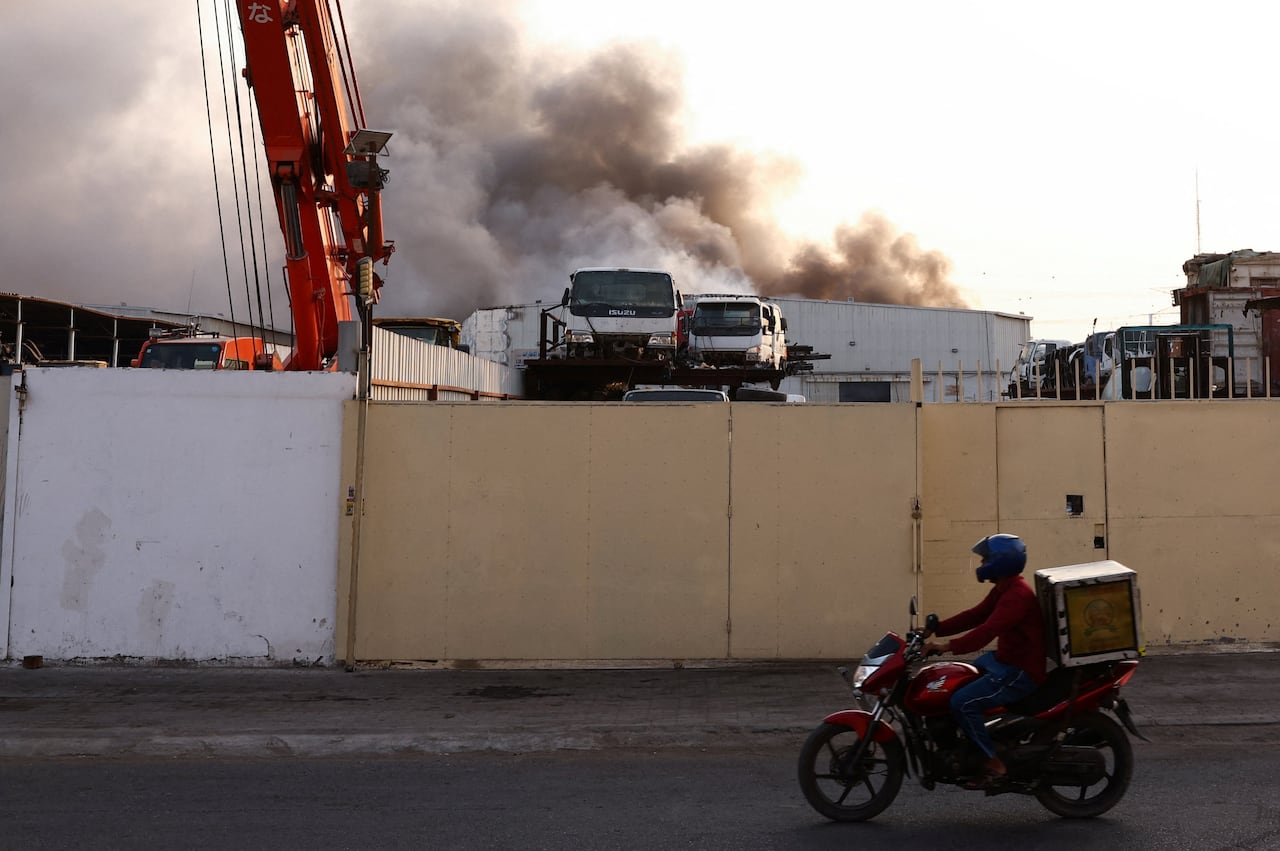
Smoke rises in Sharjah, following reports of Iranian attacks after United States and Israel strikes on Iran, in the United Arab Emirates, on March 1. (Amr Alfiky/Reuters)
Iran has thus far launched 189 ballistic missiles and 941 drones at the U.A.E., which is located directly across the Persian Gulf from Iran.
“We began hearing sounds in the sky that are unfamiliar to us in Dubai,” Masri noted.
This sentiment was mirrored by Alexander Debare, a 37-year-old entrepreneur who grew up in the capital, Abu Dhabi.
-
Tracking deaths in Iran, wider Middle East as conflict rages on
-
Analysis
Why killing Ayatollah Ali Khamenei may not mean regime change in Iran
“There were two very loud bangs,” Debare recounted. “I went up to the roof to see, and it was clear that two missiles had been intercepted. But that’s not a sound we’re accustomed to.”
Since Saturday, three individuals have lost their lives, and numerous others have been injured, primarily due to falling debris. An Iranian drone also caused a fire in a parking lot adjacent to the U.S. consulate in Dubai.
Global Affairs Canada is advising Canadians to exit the Emirates as soon as feasible, citing ongoing missile and drone threats.
Approximately 30,000 Canadians are registered in the U.A.E. Foreign Affairs Minister Anita Anand announced that she is arranging charter flights for Canadians wishing to leave the region.
“This afternoon, I instructed my officials to secure contracts for charter flights for Canadians,” she stated. “This charter is dependent on obtaining the necessary permissions from the U.A.E. government to use their airspace, which we have already requested.”
A more expansive attack
The U.A.E. has previously experienced missile and drone attacks, notably in January 2022, when Houthi rebels from Yemen targeted a fuel depot in an industrial area of Abu Dhabi, close to the airport. However, the recent assaults have been significantly broader in scope.
The U.A.E. is equipped with “advanced, layered defenses, including the Patriot missile system and terminal high-altitude area defense,” explained H.A. Hellyer, a senior associate fellow at the Royal United Services Institute for Defence and Security Studies in London. These systems enable it to protect against ballistic missiles, cruise missiles, and a range of other threats, many of which have been encountered in recent days.
As reported by the Emirates’ Ministry of Defence, the nation’s multi-tiered defense system has successfully destroyed 175 of the 189 missiles and intercepted 876 of the drones.
Get the latest on CBCNews.ca, the CBC News App, and CBC News Network for breaking news and analysis.
Nevertheless, even though the frequency of Iran’s assaults seems to have diminished in the past few days, there are worries regarding the U.A.E.’s ability to maintain its defense if the conflict continues for an extended period.
“In a prolonged, high-volume conflict, the sustainability of stockpiles — rather than technical sophistication — would be the key limitation,” Hellyer stated.
The U.A.E. has recently denied a Bloomberg report suggesting it was depleting munitions for its air defense systems.
Both Debare and Masri remarked that despite the intensifying conflict, daily life in the U.A.E. remains largely unchanged for the time being.
“I visited the supermarket,” Masri noted. “It was crowded, as were the nearby bakeries. People were still shopping and purchasing goods. So, life feels somewhat normal.”

Individuals relax in Dubai Marina on March 3. Both interviewees for CBC News mentioned that life remains relatively normal, despite the escalating conflict in the Middle East. (Raghed Waked/Reuters)
The U.A.E. has also taken the initiative to alert its residents about incoming threats, sending text messages advising them to seek shelter and informing them once a danger has been neutralized.
“You receive a message on your phone advising caution,” Debare explained, “and then, once it’s over, you get a notification saying it’s safe to resume activities. It’s very organized.”
Serious questions sure to rise
Nonetheless, experts express concern that a prolonged conflict in the area could jeopardize the U.A.E.’s hard-earned reputation as a secure and stable environment for living and investment.
“A single incident is unlikely to alter foundational perceptions,” Hellyer noted. “However, repeated or significant strikes could undermine the sense of invulnerability and accelerate deeper regional security integration.”
-
Explosion shakes Iran’s capital as Israel launches fresh attack
-
Analysis
As tensions simmer between U.S. and Iran, Iraq is feeling the heat
Fallon mentioned that numerous Gulf nations appear to be bearing the brunt of Iran’s military actions.
“I believe that once the situation is resolved, there will be significant inquiries from the Emirates, as it seems that they and other Gulf states were collateral damage in the pursuit of U.S.-Israeli objectives,” he stated.
“The U.S. and Israel appear willing to allow the Gulf states to suffer economically while they engage in this conflict.”